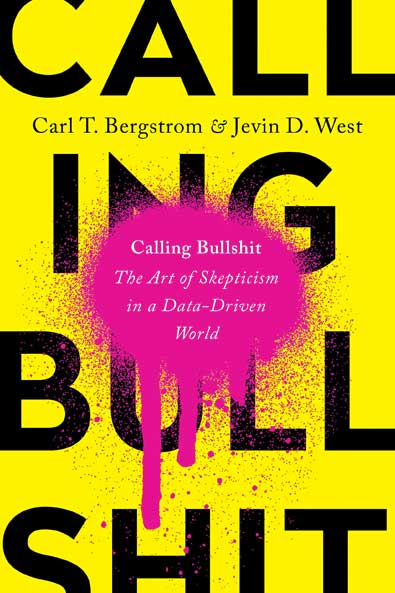

Calling Bullshit
Carl T. Bergstrom & Jevin D. West
Misinformation, disinformation, and fake news abound and it’s increasingly difficult to know what’s true. Our media environment has become hyperpartisan. Science is conducted by press release. Startup culture elevates bullshit to high art. We are fairly well equipped to spot the sort of old-school bullshit that is based in fancy rhetoric and weasel words, but most of us don’t feel qualified to challenge the avalanche of new-school bullshit presented in the language of math, science, or statistics. In Calling Bullshit, Professors Carl Bergstrom and Jevin West give us a set of powerful tools to cut through the most intimidating data.
You don’t need a lot of technical expertise to call out problems with data. Are the numbers or results too good or too dramatic to be true? Is the claim comparing like with like? Is it confirming your personal bias? Drawing on a deep well of expertise in statistics and computational biology, Bergstrom and West exuberantly unpack examples of selection bias and muddled data visualization, distinguish between correlation and causation, and examine the susceptibility of science to modern bullshit.
We have always needed people who call bullshit when necessary, whether within a circle of friends, a community of scholars, or the citizenry of a nation. Now that bullshit has evolved, we need to relearn the art of skepticism.
Related Video
Related Resources
Jung, Maslow and Meaning
March 24, 2019 Gary Lachman Jung famously remarked that the majority of people who came to him were not suffering from any neurosis or other psychological disorder, but from a
This View of Life
Completing the Darwinian Revolution
It is widely understood that Charles Darwin’s theory of evolution completely revolutionized the study of biology. Yet, according to David Sloan Wilson, the Darwinian revolution won’t be truly complete until it is applied more broadly—to everything associated with the words “human,” “culture,” and “policy.”
No More Feedback
Cultivate Consciousness at Work
Does feedback improve the bottom line of a company?
The Nurture Effect
How the Science of Human Behavior Can Improve Our Lives and Our World
An Everyone Culture
A Radical New Model for Unleashing Your Company’s Potential
Finite and Infinite Games
January 5, 2013 James Carse Finite games are the familiar contests of everyday life; they are played in order to be won, which is when they end. But infinite games

On Being Wrong
March 1, 2011 Kathryn Schulz Most of us will do anything to avoid being wrong. But what if we’re wrong about that? “Wrongologist” Kathryn Schulz makes a compelling case for